Slot: Challenge-Response
This page describes the Challenge-Response slot type available in PicoKeyApp.
This slot implements a host-driven challenge–response mechanism, where the host generates a challenge, the device signs it, and the host verifies the response.
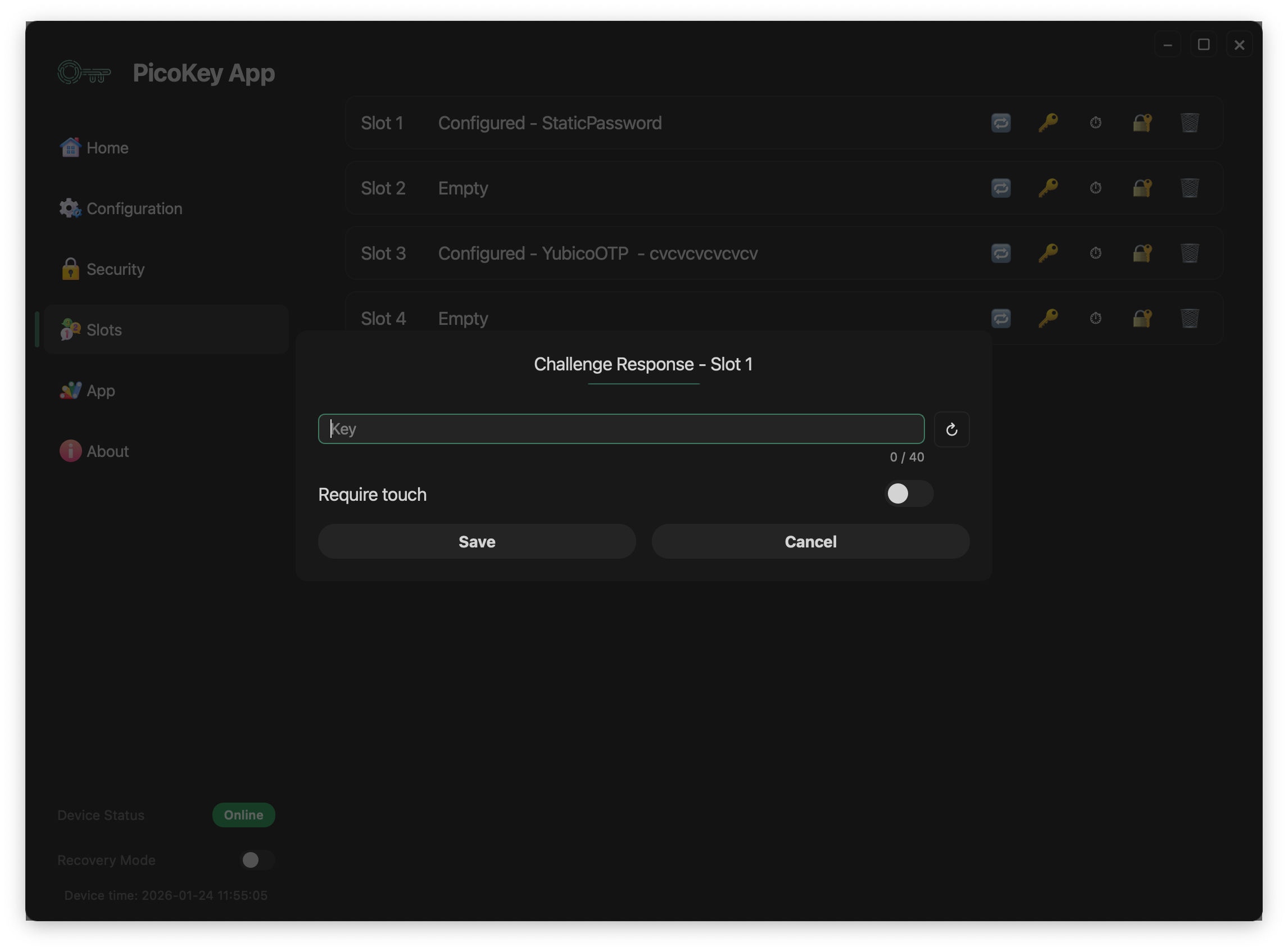
Overview
The Challenge-Response slot is designed to:
- Bind authentication to a secret stored on the device
- Require host-side verification
- Avoid storing reusable secrets on the host
The authentication flow is driven by the host application.
Authentication model
The Challenge-Response mechanism works as follows:
- The host generates a random challenge
- The challenge is sent to the device
- The device signs or processes the challenge using the slot secret
- The response is returned to the host
- The host verifies the response
- Authentication succeeds only if the response matches the expected value
Note
The device does not decide whether authentication succeeds. Validation is entirely performed by the host.
Slot configuration
Key
Defines the secret key used for challenge processing.
- The key is stored securely on the device
- The key length is limited by the slot implementation
- Once configured, the key cannot be retrieved in plaintext
Warning
Losing the key means the challenge-response authentication cannot be validated anymore.
Require touch
When enabled:
- User presence is required to generate a response
- The device waits for a physical touch or confirmation
Note
Requiring touch prevents unattended or automated authentication attempts.
Save and cancel
- Save stores the slot configuration permanently
- Cancel discards all changes
Danger
Saving overwrites any existing slot configuration.
Security properties
The Challenge-Response slot provides:
- Protection against replay attacks (if challenges are random)
- No static secrets sent over the interface
- Optional user presence enforcement
Warning
Security depends entirely on correct challenge generation and verification on the host side.
Typical use cases
Common uses for Challenge-Response slots include:
- Device-bound authentication for custom applications
- Licensing or entitlement checks
- Secure device identification
- Anti-cloning mechanisms
Tip
Always use cryptographically strong random challenges.
Limitations
- No built-in verification on the device
- No standardized protocol (application-specific)
- Host implementation is required
Note
This slot is intended for advanced users and custom integrations.